
Equity benchmark Sensex rallied 936 points on Monday, helped by heavy buying in banking and IT counters along with decline in oil prices amid hopes of headway in renewed diplomatic talks between Russia and Ukraine. A fresh round of talks is expected on Monday between Ukrainian and Russian officials. Rising for the fifth straight session, the BSE Sensex jumped 935.72 points or 1.68 per cent to settle at 56,486.02.
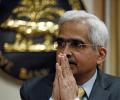
The Reserve Bank of India's rate-setting panel on Wednesday began its three-day deliberations on the next bi-monthly monetary policy amid expectations of at least a 35-basis-point hike in the interest rate to check high inflation. If raised, it will be the third consecutive hike in the repo rate -- the short-term rate at which the RBI lends money to banks. The central bank has already announced to gradually withdraw its accommodative monetary policy stance.

If the pattern over the last three months is going to continue, the likelihood is that both indices will register inflation rates close to current levels over the next few months.

Prices have continued to move up in Delhi's markets, wholesale and retail, on supply worries and spoilage due to record cold weather.
The RBI's rate-setting panel MPC on Monday began its three-day deliberation amid expectations of another round of hike in benchmark interest rates to contain inflation that continues to remain above the central bank's upper tolerance level. RBI Governor Shaktikanta Das will announce the decision of the Monetary Policy Committee after deliberations on Wednesday. Das has already indicated that there may another hike in the repo rate, though he refrained from quantifying it.

Spiralling prices pinched the pocket of consumer as edible oil, fuel and many other commodities turned dearer this year amid pandemic-induced disruptions but the inflationary pressure is anticipated to ease, though marginally, in the coming months. As consumers, at retail as well as wholesale levels, are willy-nilly learning to live with the new normal of curbs to contain the spread of coronavirus infections, experts are of the view that elevated inflation is likely to stay longer. After dealing with the devastating blows from the second COVID wave, especially during the April-June period, the economy is well on the revival path but the emergence of Omicron might unsettle the recovery trajectory in the short term.

The government on Tuesday imposed restrictions on sugar exports from June 1, a move aimed at increasing availability of the commodity in the domestic market and curbing price rise. "Export of sugar (raw, refined and white sugar) is placed under restricted category from June 1, 2022 onwards," the Directorate General of Foreign Trade (DGFT) said in a notification. However, it said that these restrictions would not be applicable on sugar being exported to the EU and the US under CXL and TRQ. A specified amount of sugar is exported to these regions under CLX and TRQ.
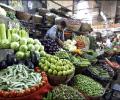
Inflation, as measured on the Wholesale Price Index (WPI), has been in the negative zone since November 2014.

A careful reading of the national income accounts suggests that after a strong recovery from the pandemic, there has been a significant ebbing of dynamism over the last three quarters to more modest levels recently, note Arvind Subramanian and Josh Felman.

...to fund the revenue gap. Of the gross market borrowing of Rs 14.13 trillion estimated for FY25, Rs 7.5 trillion, or 53 per cent, is planned to be borrowed in the first half.

The rupee on Tuesday recovered from its all-time intra day low of 77.79 to close higher by 7 paise on a stellar rally in domestic stock markets. After opening lower at 77.67, the local unit plunged further to its all-time intra-day low of 77.79 due to a spike in crude oil prices and disappointing macroeconomic data. However, a strong rally in domestic equities helped the rupee rebound and close at 77.48 (provisional), showing net gains of 7 paise over the last close of 77.55. The forex market was closed on Monday on account of Buddha Purnima.

RBI might retain rates at current levels, upside risks to inflation rise.


Asian Paints was the top loser in the Sensex pack, shedding 2.66 per cent, followed by Axis Bank, HUL, Wipro, M&M, HDFC and Bharti Airtel. On the other hand, TCS, Infosys, L&T, Tech Mahindra and HDFC Bank were among the gainers.
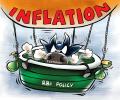
With pricing power of producers unlikely to strengthen and commodities ex-crude oil likely to remain sluggish in the immediate term, the core-WPI inflation may remain sub-zero in the rest of this calendar year.

The annual rate of inflation based on monthly wholesale price index (WPI) was 1.22 per cent in December as compared to 1.55 per cent in the previous month. It was 2.76 per cent in December 2019. The decline last month was mainly due to lower increase in food prices, data released by the Ministry of Commerce and Industry showed on Thursday. The food inflation for December dropped to 0.92 per cent as compared to 4.27 per cent in the previous month.

From the 30-share pack, Infosys, Tech Mahindra, TCS, HDFC, HDFC Bank, Wipro and HCL Technologies were among the major laggards in early trade. Nifty tumbled 314.95 points to 17,160.70.

ITC was the top gainer in the Sensex pack, rising around 3 per cent, followed by HDFC Bank, PowerGrid, ICICI Bank, IndusInd Bank and NTPC. Nifty surged 176.80 points to a new lifetime closing high of 18,338.55.

The annual rate of inflation based on monthly wholesale price index (WPI) was up at 1.32 per cent in September as compared to 0.16 per cent in the previous month.
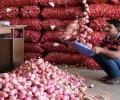
Onion is currently trading between Rs 70 and Rs 80 in retail markets across the country.

The wholesale price index inflation is projected at 6.4 per cent for 2017-18.

As many as 34 new drugs were added to and 26 dropped from an updated list of essential medicines on Tuesday, with the government saying this will reduce "patients' out-of-pocket expenditure". The National List of Essential Medicines (NLEM 2022) has 384 drugs, up from 376 in 2015. "Drafting this list is a lengthy process, and around 350 experts from across India have held over 140 consultation meetings to draft the NLEM 2022," Union Health Minister Mansukh Mandaviya said.
Experts say given the annual inflation, the increase might not be substantial for the industry, which has to deal with rising cost of manufacturing, raw material as well as packaging and logistics.

Assembly elections in Maharashtra are scheduled later this month. The farmer protests are likely to affect the results, especially in the onion-growing belt of Nashik.
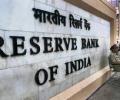
Inflation, remained in negative territory for the 7th month in May
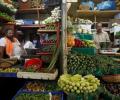
Not just onion, retail prices of potato and other vegetables have also shot up in the national capital on Monday as recent winter rainfall has damaged some of the crops. Milk and butter prices have also gone up. Even cooking oil prices, especially of mustard oil, have increased by Rs 15/kg litre.

India economy clocked a five-year high growth rate of 7.6 per cent in 2015-16.

In August, wholesale prices rose 3.74 per cent year-on-year.

The rupee depreciated 6 paise to 77.50 against the US dollar in the opening trade on Wednesday as a surging American currency in the overseas markets and persistent foreign fund outflows weighed on investor sentiment. Besides, rising global crude prices impacted the domestic unit, forex traders said. However, a higher opening in the domestic equity market restricted the rupee's fall, they added.

The price of export quality lady's finger, for example, shot up 150 per cent in two weeks to close on Thursday at Rs 40 a kg against Rs 16 a kg on September 16 in the Agricultural Produce Marketing Committee, Vashi, near Mumbai.

'Revision of the base year for both CPI and GDP are long overdue.' 'The basic data that went into the 2011-2012 series were mainly from surveys done in 2011 or earlier.' 'We have since seen the emergence of new sectors like platform-based work and online marketing.' 'The employment surveys and the consumption surveys need to reflect these adequately.'
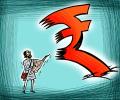
The rupee appreciated 7 paise to 79.74 against the US dollar in early trade on Thursday as a positive trend in domestic equities supported the local unit. However, a strong American currency overseas and forex outflows restricted the rupee's gain, dealers said. At the interbank foreign exchange, the rupee opened at 79.72 against the American dollar, then went lower to trade at 79.74 against the greenback in early deals, registering a gain of 7 paise over the last close.

The government regulates prices of all other medicines.
Consumer price inflation touched a nine-month high of 11.24 per cent last month.
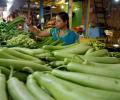
Not only primary vegetables, but also additives like garlic, ginger and chilly have recorded a sharp increase in prices

Already retail inflation has risen to 6.07 per cent in February, crossing the upper band of the Parliamentary mandate. This is the second consecutive month in 2022 when retail inflation has crossed the 6 per cent mark having hit 6.01 per cent in January.
However, prices of most agricultural items, barring potatoes, onions and wheat, continued to rise.

Street expects RBI to keep CRR unchanged, opt for open-market operations to ease liquidity
Food prices rose 8.12% year-on-year last month, slower than an annual rise of 8.80% in January.

The Wholesale Price Index-based inflation was (-)4.54% in Sep.
 © 2026 Rediff.com - Advertise with us - Disclaimer - Privacy Policy - Sitemap - Feedback - About us - Terms of use - Grievances